The Story of Leo


Former Vick dog heals hearts

Speak clearly, if you speak at all; carve every word before you let it fall. -- Oliver Wendell Holmes


By Randi Bildner


Words are tools that wield incredible power; used effectively they can make a positive contribution to society. Unfortunately, sensationalism and the promise of the sale can skew reality and turn innocent statements into dangerous rhetoric.

Such is the case for the sad situation facing many pit bulls in this country and around the globe.

Leo is the name Certified Dog Trainer Marthina McClay chose for the American Pit Bull Terrier who made his way into her loving arms on December 16, 2007. McClay rehabilitated the animal,and then, in just five short weeks, turned him into a therapy dog. His name (a reference to “Leo the Cowardly Lion”) was chosen as a testament to his meek demeanor—a sharp contrast to the public perception of the pit bull.

McClay’s accomplishments would be impressive for any dog or any trainer for that matter— but Leo is not your average canine.

In April 2007, Leo, along with 50 other pit bulls, made worldwide news when he was confiscated from suspended NFL player Michael Vick’s home in Smithfield, Virginia. Evidence indicated that Vick was running a full fledged dog fighting ring under the guise Bad Newz Kennels.

Now serving much-deserved time in prison for the atrocities committed on his property, the former football star is also digging deep (by court order) into his well-padded pockets to pay to rehabilitate this once-fighting dog Leo along with the 47 other remaining dogs who have been sent to trainers and sanctuaries around the country.

It is important to note: of the 50 dogs confiscated at Vick’s property only one was deemed too aggressive for rehabilitation. Unfortunately, one additional dog was euthanized when it was discovered he was suffering from cancer.

Well aware of the media’s uncanny ability to misrepresent facts about pit bulls to create sensational headlines, McClay is extremely protective of Leo’s reputation. It became her mission to make it impossible to misread Leo’s intentions. McClay cleverly dresses Leo in a clown collar when he is “on the job,” visiting oncology wards and other medical institutions.

Leo’s intentions are undeniably clear as he places his huge head on the lap of a distressed patient. With deep, soulful eyes he peers directly into their hearts, causing them to muster a smile. For a few moments, all is well with the world—as Leo brings light to someone facing a dark day.

Each time the media puts a negative spin on a story to grab a headline; it is a tacit endorsement of the people who are part of this unsavory sub-culture. McClay points out, “With each misstatement these dogs are being pushed further underground and away from society.”

McClay is the founder of Ourpack.org, a San Francisco-based organization that rehabilitates pit bulls— including “fight bust dogs” like Leo. McClay credits these dogs in particular for teaching her much about the world of dog fighting.

What McClay learned is contrary to what most people believe and would be very surprised to hear: these dogs do not want to fight. McClay states, “The fear in their eyes clearly tells the story,” saying, “The dogs are shoved and pushed into the ring or pit leaving them no place to go.” According to McClay, dog fighting is something dogs are forced to do by horrible means and do not enjoy.

The understanding gained from fight bust dogs supported what McClay observed throughout her years of experience, confirming her theory: insecurity, fear and in some cases lack of socialization were often incorrectly interpreted as aggression.

Ironically, McClay believes that Leo is the most balanced American Pit Bull Terrier she has ever known, saying, “He is extremely confident with people; his behavior clearly showed that he did not want to fight.” Leo shows his love for his fellow canines too. He now resides with McClay along with two additional pit bulls and a Chihuahua Pug mix.

Calling pit bulls “biddable”—willing to do what is asked and very obedient—they are actually loyal to a fault, which it the very tendency that can lead to trouble when placed in the wrong hands.

With proper assessment and training many pit bulls can thrive as therapy dogs.

McClay states, “One thing you can’t teach a dog is to want to love; this is simply in their nature; you can’t just make a therapy dog.” Unlike fighting, love is innate; it is something that cannot be taught.

Leo’s work is a multi-faceted service. Not only does he bring joy to those in difficult situations, he is showing the world what he is all about. He clearly demonstrates the fact that when nurtured and loved, pit bulls can make an incredible contribution to the world.

Additional credentials:
Marthina McClay, CPDT
AKC Certified CGC Evaluator
Certified Tester/Observer
for Therapy Dogs, Inc.
Animal Behavior College Mentor Trainer


www.ourpack.org
www.dogtrainingforpeople.com

Visit Randi Bildner's wonderful website The Bully Beat http://thebullybeat.org/

Photo courtesy of Stephanie Lam of Our Pack

Pilots N Paws Organizing a fly-in on June 20th


Fly-In to save lives is scheduled for June 20, 2010.

Pilots N Paws is having a fly-in on June 20th. There is a list of locations where pilots are coming from and flying back. The flights are free, completely volunteer, and all you will need to do is meet the pilot at the airport to pick up your animals!


The website for Pilots N Paws is www.pilotsnpaws. org

The list of locations are as follows:
-St. Augustine, FL
-Bessemer City, NC
-Emmitsburg, MD
-Lexington, KY
-Heath Springs,SC
-Flagstaff, AZ (flying commercially, could take small in cabin animal)
-Meansville, GA
-Midland, MI
-Chesapeake, VA
-Waxhaw, NC
-Knoxville, TN
-Williamsburg, VA
-Kansas City, MO
-Athens,GA
-Memphis, TN
-Baltimore, MD
-Norwalk, CT
-Gettysburg , PA
-Savannah, GA
-Chattanooga, TN

Their website is intended to be a meeting place for those who rescue, shelter or foster animals, and pilots and plane owners willing to assist with the transportation of animals. It is not the intent of Pilots N Paws to coordinate or arrange those providing these valuable services, but to provide the environment in which those involved can come together in a common place and arrange or schedule rescue flights, overnight foster care or shelter and all other related activities.
Website is http://pilotsnpaws.org/
Facebook is http://www.facebook.com/pilotsnpawsfanpage


.

Cute Birds Wallpaper


Nurse Mare Foals: Thoroughbred Horseracing's Invisible Victims


by Mat Thomas - www.animalrighter.org

For decades, the thoroughbred racehorse industry has practiced a shockingly cruel breeding method that activists have only recently brought to light. The result of this compulsory procreative procedure are nurse mare foals — the unwanted offspring of female horses used as nursing surrogates for thoroughbred ponies. Every year, tens of thousands of these horses are killed or orphaned simply because they are useless to a multi-million dollar enterprise that thrives on equine exploitation.

Here's how it works: in order to get thoroughbred mares to produce as many potential racehorse champions as possible, breeders push their biological limits to extremes by forcing them to reproduce once a year. Maximizing productivity requires breeders to have the mares reimpregnated right after giving birth, which precludes them from nursing their own babies. The newborns are therefore taken away from their mothers within days of delivery, and nursed by surrogate mares (of “inferior” breeds) who have just given birth to their own offspring — the “by-products” of this process are known as nurse mare foals.

Permanently separating thoroughbred babies from their mothers is tragic enough, but nurse mare foals usually face a far worse fate. While some are killed soon after being born or starved to death, others are sold (as young as one day old) to the tanning industry which slaughters them and turns their skin into handbags, belts, and other high-grade leather products.

The lucky ones are rescued by horse advocacy groups, which, just like the tanners, must pay the going rate of $250 to $350 apiece — and then spend several hundred more dollars feeding and raising each horse until they are ready for adoption.

Rescuers nourish nurse mare foals by bottle-feeding them milk replacer, which could theoretically be used to feed thoroughbred foals as well, thus eliminating this exceedingly inhumane breeding practice altogether.

There are two main reasons that they don't do this: formula is expensive, and horse breeders maintain that thoroughbreds need to drink real (albeit surrogate) mother's milk from the source to achieve peak performance. Plus, the larger nurse mare farms (concentrated in New York, Kentucky and Tennesee) produce 50 to 100 foals a year, and it is more operationally efficient to make the surrogate mothers do all the work rather than paying human caretakers to feed the foals by hand.

Another possible solution to producing unwanted foals is a new domperidone-based drug protocol that induces non-pregnant mares who have given birth before to lactate. Though chemically manipulating horses' hormones poses ethical dilemmas, in practical terms it would prevent tens of thousands of unwanted foals from being born into a life of suffering and untimely death. It could also dramatically reduce the number of surrogate nurse mares by enabling thoroughbreds who are too old for breeding to nurse foals.

There are many ways to help relieve the suffering of nurse mares and their orphaned foals, from urging elected legislators to pass humane laws to financially supporting horse advocacy organizations or adopting a rescued foal. Learn more about how to take action by visiting lastchancecorral.org

2nd Annual Washington DC Week for the Animals May 29-June 6, 2010!


Animal World USA

(Washington, DC) Animal World USA is pleased to announce the 2nd Annual Washington DC Week for the Animals will kick off Saturday, May 29, 2010 and run through Sunday, June 6, 2010. The exciting celebration is again designed to celebrate and recognize the unique and life-changing role that animals play in the lives of citizens through all walks of life.

The week will underscore community spirit throughout the Washington, DC Metro area as people come together on behalf of the amazing animals. To further add to the excitement, the 23rd Washington Humane Society’s Bark Ball will take place June 5, 2010! George Washington Law School will once again host a wonderful law night, featuring a panel of leading attorneys and advocates, that will be transformative to all in attendance.

The 2nd Annual DC Week for the Animals will be bringing together educators, animal shelters, humane organizations, sanctuaries, restaurants, businesses, students, musicians, artists, community leaders, decision makers and caring citizens in an action-packed compassionate week of community activities for the animals! This extraordinary week will feature a multitude of awesome fun-filled pet adoption events, events for the farm animals, festivals and blessings of the animals, free and low cost spay/neuter opportunities, microchipping, unique ways to help the horses, library storytelling events, vaccinations, wildlife activities, pet therapy, pet food/supply donation opportunities to help local orgs, vegetarian get-togethers, a salute to the military and so much more!

Please feel free to contact us by phone and/or email. We will also be working with publishers to have books donated and education underscored in the metro communities.

Precious lives will be saved and communities transformed during this incredible week. The 2nd Annual Washington, DC Week for the Animals will build new relationships for the animals and save precious lives once again. Visit the official website for complete contact and event information at
http://www.dcanimals.org/

North Carolina Students say Thanks to Ft. Bragg K-9's and Handlers


Irwin Intermediate School present thank you cards to the Ft. Bragg K-9's and Handlers!

During 3rd Annual North Carolina Week for the Animals which transpired May 1-9, 2010 Irwin Intermediate School made colorful cards for the Ft. Bragg soldiers and working K-9's. These sweet cards (as only young ones can create) were a way for the school to show their appreciation for the sacrifice and courage the soldiers and dogs give to our country.

Stacey Crawford, 6th Grade Teacher at Irwin Intermediate School in Fort Bragg, NC said "It was fantastic! Thank you for allowing our students to be a part of this special NC Week for Animals." Irwin Intermediate Teacher Deborah Popour also expressed her sincere gratitude.

The students were visited by two handlers from Ft. Bragg ...Sergeant Webster and Staff Sergeant Wade and of course coming along was one of the awesome working K-9's, Barron. After the visit, Sgt. Webster said, "It was great. It means a lot to us to receive the cards from the students. We don't normally on our daily business receive this feedback, and it really makes us know that we are appreciated."

A big thank you to Dr. Tim Howle, principal of Irwin Intermediate School and teachers who helped to coordinate this activity. Thanks to the students for creating the beautiful cards and taking the pictures.

This just serves to remind us all that when we say thank you it can changes lives. A salute to all our courageous troops wherever they are. Animal World USA also extends our gratitude and say "We love you!"

Amazing Moms of the Animal Kingdom


Emperor Penguin
Successfully raising a chick is a truly remarkable accomplishment for this mom and dad. Courtship for a typical couple starts in March and April when temperatures in the Antarctic are around -40 degrees Fahrenheit. Emperor Penguins are also serial monogamists and will wait for their previous year's mate before breeding again. The female produces one egg and leaves it in the care of its father while she makes the nearly 74-mile journey back to sea to capture the fish that she will need for feeding. Upon returning to the nesting site, she must relocate her mate and chick. Then, the pair switches off caring for their offspring, while the other makes the same long journey to the ocean and back for food. Help out these amazing moms at The World Wildlife Fund


Harp Seal
As if raising a child on a moving sheet of ice patrolled by Polar Bears and fur poachers wasn't hard enough, the harp seal mom nurses her pup on 48% fat seal milk continuously for 12 days without eating. Her pup will gain an average of 5 lbs. per day during this 12-day nursing period, while mom herself will lose about 7 lbs. per day.


Koala Bear
Relying almost entirely on eucalyptus leaves for her diet, the Koala Bear mom rarely leaves the safety of her treetop home. The mom gives birth to a quarter-inch long joey, a hairless, blind, and earless version of herself. The joey stays in her unique pouch for about six months where it slowly grows from a diet of only her milk. After six months, the joey crawls out of the mother's pouch and takes up a place on to her back, where it will remain for another six months.


Meerkat
Meerkats live in packs of about 20, dominated by one mating pair that give birth to 2 to 5 pups in a litter, with up to four litters a year. In a group of meerkats with so many new pups, it is often the aunts and sisters of the group who care for the young. After 21 days underground, the pups emerge to join the foraging party, where they learn the skills needed to live in the Kalahari Desert.


Queen Bee
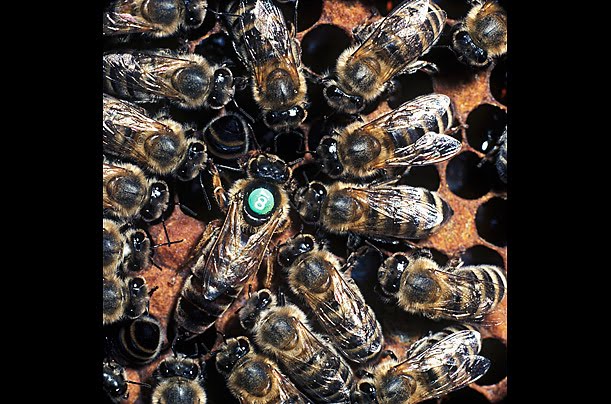
Living like a queen isn't necessarily true for the Queen Honey Bee. On a warm day, she will mate with 12-15 males, or drones. But mating this one time is enough to fertilize her eggs for 2-7 years. Once mated, the Queen will lay around 2,000 eggs a day during the springtime throughout her life.


Orangutan
The only exclusively Asian living genus of the great ape, the orangutan is considered "critically endangered" but with a reproduction cycle of about 6 to 7 years between offspring, repopulation has proved difficult. It does not help that orangutans reconstruct their homes of leaves and sticks every single day, meaning that a typical mom lives in about 30,000 new homes during her lifetime.


Polar Bear
A habitat where the average winter temperature can reach -40 degrees Fahrenheit isn't exactly ideal for raising young, so mother polar bears dig an underground den where they remain in a hibernation-like state through the coldest winter months. Mothers birth between November and February, to a litter that almost always consists of two cubs, who then live in the safety of the den while nursing on the fasting mother's milk. At the end of this period, the family emerges from the den and eventually makes their way to the moving sea ice, where the mother can catch seals once again. At this point the mother has been fasting for up to eight months, while raising two hungry cubs.


Seahorse
Talk about role reversal: Many of the functions performed by females in most species are handled by dad in seahorse couples. Mating takes place when the female seahorse deposits dozens to thousands of eggs inside the male's brood pouch, as the male releases a cloud of sperm to fertilize them. The eggs become enveloped in tissue and receive everything they need from dad including a hormone usually only seen in females. Mom remains relatively absent during this time and visits once a day, to re-secure the bond with the father.


African Elephant
The largest land mammal also has the longest pregnancy in mammals, averaging a staggering 22 months. Elephants usually give birth to one calf, who will rely on the mother's milk for around 4-6 years. One would think that years of devotion to her calf and the protection of the herd would lead to a healthy adult elephant, but in reality, very few calves live to adulthood.


Giant Pacific Octopus
A female Octopus has only one goal, to have one successful brood of eggs in her lifetime. A female octopus will lay around 200,000 eggs in her lair and defend them at any cost. During the one month of caring for her eggs the female is starved almost to death and may even ingest one of her own arms before she will leave her eggs for food. Once the eggs hatch, the offspring float around in blooms of plankton while their mother wanders out of her lair, too weak to defend herself, often falling prey to predators.